|
Now that your eggs have arrived, you should carefully unpack this box and inspect your eggs immediately. Check for cracks in the eggs and discard broken or suspect eggs immediately. Please remove the extra tissue packing or bubble wrap around each egg and return the eggs to their carton or other hatching tray.
Store them in a cool (NOT cold) dark place for a maximum of 48 hours to ‘rest’ before you attempt to begin incubation. Your must turn the eggs 3 times per day during this ‘resting period’ to prevent the yolks from sticking to their shells. To do this, use 2 or 3 books laying on their sides (about 2-3 inch tall stack) and prop up one end of the egg carton. Each time you turn the eggs, turn the carton so that the opposite end is propped up. Turning them an odd number of times each day is the standard recommendation. I like to keep an extra turning tray in operation while I’m storing any eggs so that I don’t have to think about it at all.
Incubation – it’s always best to follow the instructions that came with your incubator as each unit is designed differently and there are no one size fits all instructions for every climate. I HIGHLY recommend a forced air unit equipped with an auto-turner to all part time and novice hatchers, as they are easier to manage. The following is a general reference guide for your convenience.
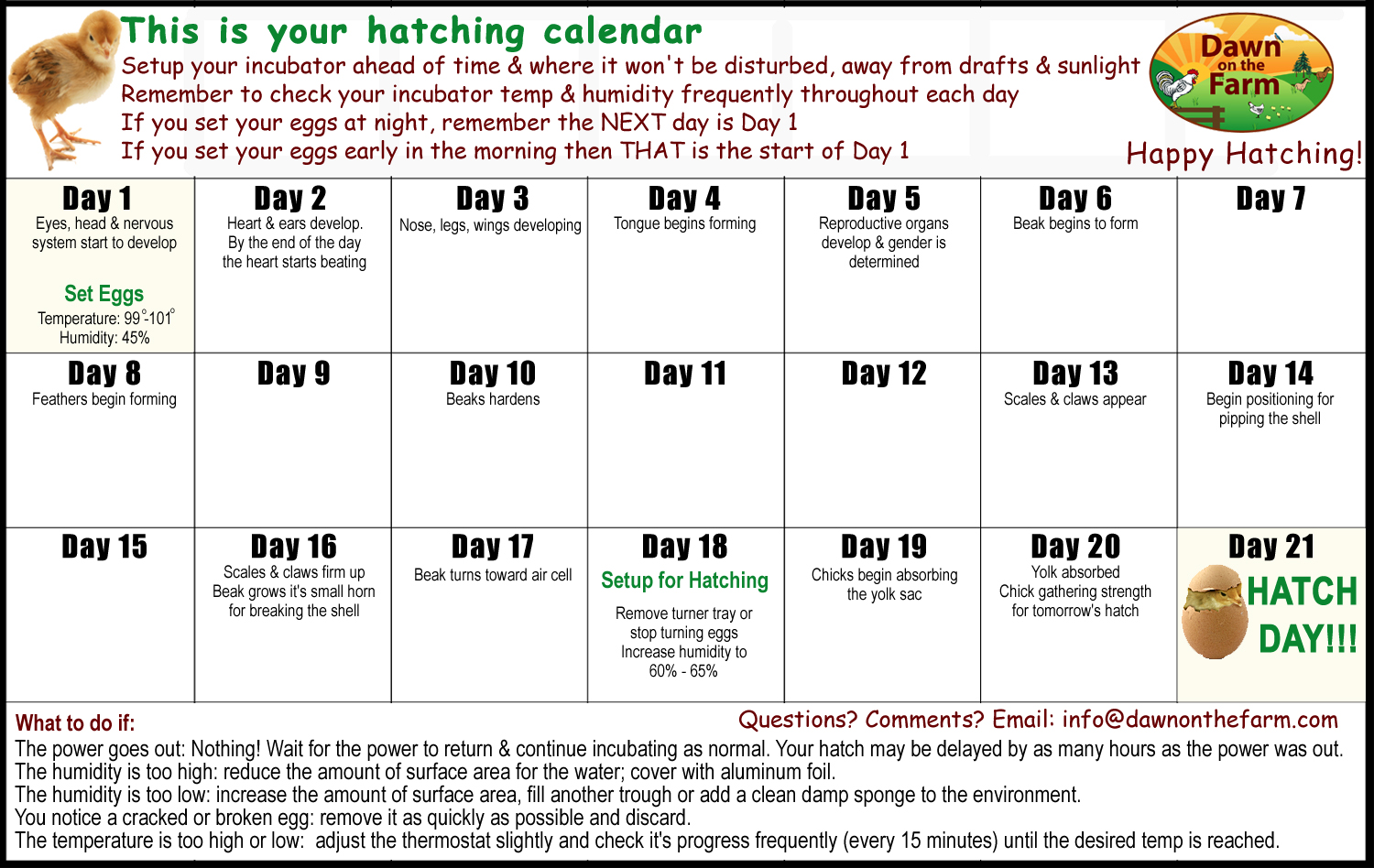
It takes approximately 21 days for chicken eggs to hatch.
Incubator Temperature: 99-101F for the entire 21+ days Incubator Relative Humidity: +/- 45% Days 1-18 and +/- 60% Days 19 through hatch time.
Once the chicks begin breaking through the shells, the humidity will increase slightly on it’s own. You needn’t go overboard on day 19 increasing humidity. I find it’s more a matter of being sure you won’t run OUT of water in the next 3 days without opening the lid. Also, during spring thunderstorms and conversely summer drought, your water requirements inside the incubator will change. This is the best reasons to take good notes while you get to know your incubator and through several hatches.
 |
|
|
 |
|
|
These chicks were hatched in a paper egg carton flat. 19 chicks around the perimeter, this is the day I transfer them to the brooder. I use the “carton method” for hatching on every single hatch. I believe that if you incubate eggs upright in turning trays, that you should hatch them upright as well. It’s not natural, but neither is using a turning tray to turn your eggs.
|
|
“Stability over Perfection” is my rule of thumb. The “perfect” recipe for hatching chicks is UNDER A HEN, so let’s give up on the notion right now, that you could do a perfect job of incubation. Instead, your going to do the best artificial job you can by simulating nature as effectively as possible. There is a temperature range for incubators because ALL of those temperatures can work, same for humidity.
What DOESN’T work is allowing the conditions to swing wildly from one extreme to the other DURING embryo development. You see, I’ve hatched healthy chicks at too high temps, too low temps, no humidity conditions AND too high humidity and ALL with great success. And then there were clutches in the beginning, where I let the incubators swing wildly around to ALL of those conditions in the 21 days, and about half of those chicks, unfortunately suffered and died. This learning experience was devastating, and nearly put me off of hatching chicks forever.
I now know that the MOST important factor is having constant climate conditions. Make certain that your incubator is stable for a couple of days before you even begin. THEN incubate a dozen infertile or throw away eggs, for a few days, so you can see how your incubator will behave. The temps & humidity will change once you add eggs, and then reach an equilibrium in a day or two after that. THAT is ultimately the climate you’ll have to fine tune... how the incubator runs with eggs IN it. You have to give it a few days to balance out, and a good few hours after each and every tiny adjustment you make to the water or temperatures. Keep a journal and write down your results several times per day. Check conditions using a digital thermometer/hygrometer combo that you can purchase from a reptile supply store or Amazon this is what I use. You MUST calibrate your thermometer, there are many good articles online (try the forums at www.BackyardChickens.com ) on how to do this. Calibrating will help you understand how far off the temperature readings are from true. For instance, mine reads 97.6 at the perfect incubation temperature. This is actually 99.5 F which I learned by calibrating & testing. I find the hygrometer to always work sufficiently as a guide to the humidity level so long as the batteries get a new change each season.
Spare yourself some worry & heartbreak. Try NOT to learn how to properly adjust and operate your incubator on potential baby chicks if you can avoid it... as there is NOTHING more discouraging and heart breaking, than to be responsible for bad hatch. Things may go wrong, but a little practice first will minimize potential risk.
For more information on Incubation & Brooding I highly recommend www.BackyardChickens.com online forum for Incubating and Hatching Eggs; where help and advice is available 24 hours a day.
DO NOT REMOVE THE CHICKS FROM THE INCUBATOR for at least 24 hours after hatching. It is best to wait until they are fluffy and dry before moving them to the brooder. They can live on the egg yolk they absorbed right before hatching for up to 2 days, they are in no danger staying in there for 24 hour to acclimate to being outside the shell. Chilled chicks die; do not take chances with your new baby hatchlings.

|